

Just about every day I take a walk along a residential road, admiring the beautiful landscaping in front of many of the houses—palm trees, brightly colored flowers, and flowering trees in full bloom. As someone who plants garden beds for a living, I can’t help paying close attention to the design. What colors did they combine? How did they overcome a challenge? Where did they add lighting?
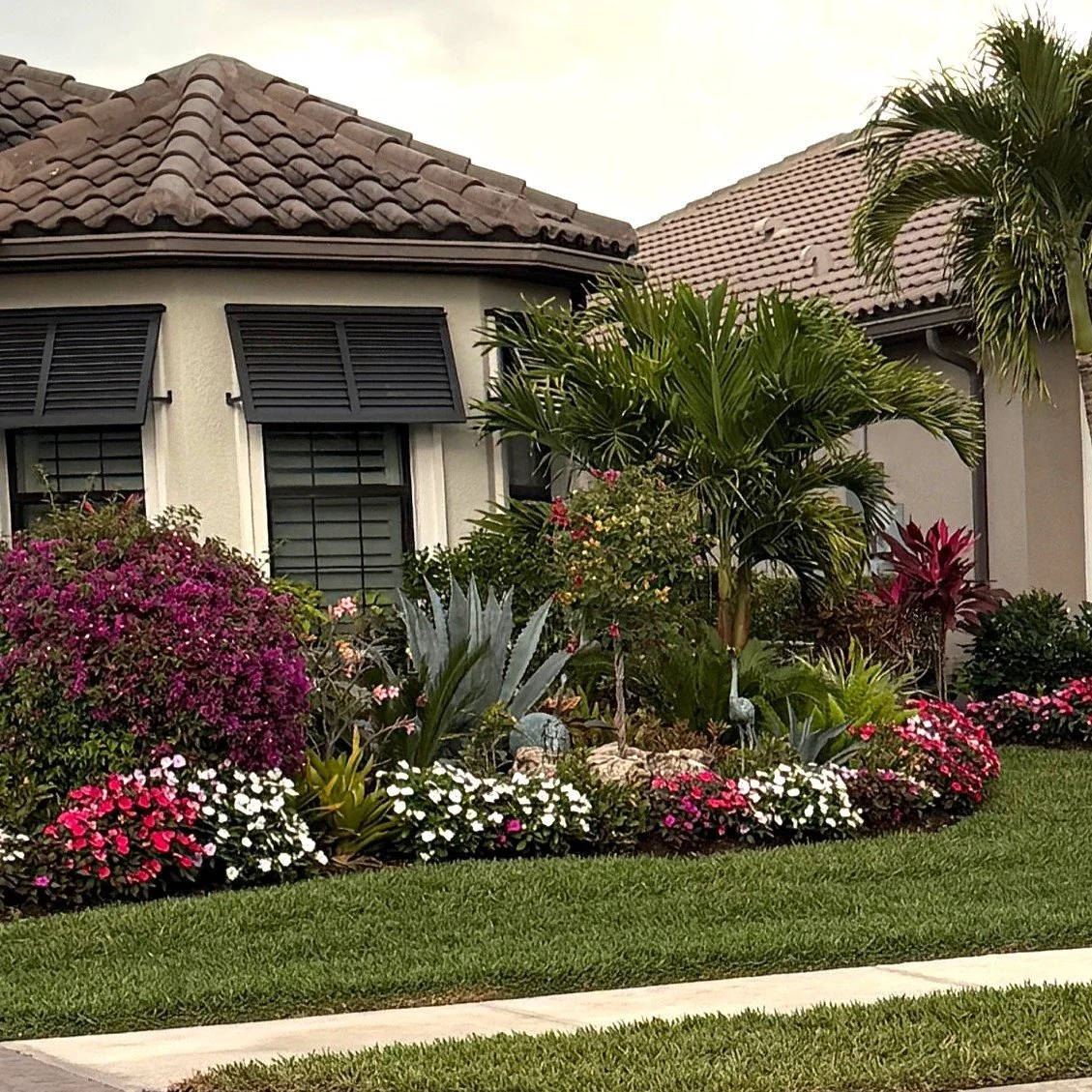
Beautiful landscaping on my walking route.
Most of the gardens look very nice. Pretty flowers. Lots of color. Pleasant to look at. But others are just…wow. These gardens are above and beyond—landscaping that stops you in your tracks. Same neighborhood, same size lots, and similar houses.
So, what makes the difference?
It usually comes down to three common elements: height variation, multiple plant types, and incorporating white flowers. Each one helps focus your attention or draws your eye to a certain part of the garden, but in different ways. Let’s take a look at each:
Height Variation
When all the plants are the same height, your brain automatically skips over them. There’s nothing to “stop the scroll.” Just like a uniform in the military is designed to hide the individual, uniform plant height doesn’t catch your eye. It also looks too perfect; plants don’t grow at the same rate, and the variation is part of the appeal.
One garden in particular intrigues me. It always draws me straight into it. After studying this design for a bit, I realized why: The plants are arranged in gradually increasing heights, but in a way that feels natural rather than structured. It looks like an overgrown path, inviting you to step in and see where it leads.
Multiple Plant Types
A field of tulips is a spectacular sight. But a small garden with only one kind of flower simply can’t have the same impact. A small garden of one plant type can look lovely—especially when the colors vary (think white and purple petunias or fuchsia and pink geraniums). And yes, the same flowers grow side by side in nature. But relying on a single flower type puts the garden at risk of looking too organized and basic.
I have a client who likes his garden in all one color. The first year we worked in pink. He was okay with different shades but wanted to stay within that one color family. I used three different plant types and designed the bed so it was balanced in type, hue, and height. He was absolutely delighted. He’d planted himself in the past and never imagined a bed could turn out like this. Now, each year, we choose a new color and use different plants and sizes to create interest. (In case you’re wondering, 2026 will be yellow!)
Integrating White Flowers
One big difference between “nice” and “wow” is including white in the design. Many times, a stone is light gray, so you might assume white would blend in and mute the whole design. In reality, white flowers play off the other colors and make the entire garden more vibrant. White also stands out amongst the greenery, so you automatically stop and notice.
I was reminiscing with my mom about this the other day. When I first started grave tending, she would join me at the nursery. It seemed like every time I set out a design on a table, she’d glance at it, say, “You need some white,” then dart off to grab white petunias or alyssum. She’d set a container down on each side of the middle triangle and step back. Nine times out of ten, she was spot on. Mom doesn’t usually come to the nursery with me these days, but I still hear her voice in my head: “You need some white!”
Putting It All Together
The bottom line is to consider all three elements when you want to bring your design to the next level: height variation, flower variety, and white flowers. Of course, not every design needs all three, and too much of a good thing can get overwhelming, like a fistful of rainbow sprinkles on every donut in the box. As always, it’s about balance.
Start with your basic design. Once you’ve picked out the main flowers, set it all on the ground or a convenient tabletop. Step back and look. Is it bland? Add a splash of white. Too uniform? Add some spike plants or larger flowers like purple salvia. Ask yourself: Do I have a variety of flower types? Is there interest without oddity? Don’t be afraid to play around with it!
Occasionally, it takes me extra time in the garden center because something about the design feels “off.” And sometimes I need to tell myself to leave it alone and stop fussing. It’s okay to leave the nursery with an imperfect design. It can always be adjusted in the cemetery. Hopefully you keep a few extra flowers with you for just such a situation.
Remember Your Clients
Of course, always keep your client’s preferences in mind. If someone wants only geraniums, then do your best to create a stunning bed of geraniums. Did a client specify their dad was military and would prefer a structured garden? Or how about a client who asks for a natural design, something “that feels like a meadow.” There are many ways to turn your clients’ concepts into something beautiful. It just takes a little imagination.
As we look ahead to spring, keep these three design elements in mind. Step back and ask yourself whether the bed has enough points of interest. And be willing to trust your eye! The more experience you have, the more natural it will be to plant graveside gardens that stand out. And who knows, maybe you’ll start to hear a voice in your head saying, “You need to add some white!”